


Oral appliance therapy: the mouthguard everyone's talking about
You've almost certainly seen the ads by now. Something between a sports mouthguard and a retainer, with a pitch that sounds too easy to be true: wear this at night, skip the CPAP mask and hose, breathe better. No machine on the nightstand, no straps across your face, no hum at 3am.
When a product promises to replace a gold-standard treatment with something smaller and simpler, skepticism is usually warranted.
This one is a real exception. There's legitimate research behind it. But it isn't a fix for everyone, and being clear about who it helps matters far more than the device itself.
What is oral appliance therapy?
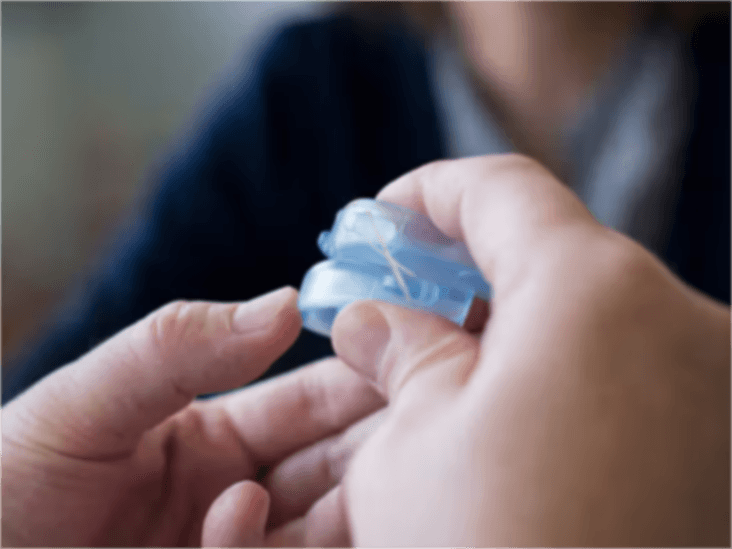
The clinical name is a mandibular advancement device, though "jaw-shifting mouthpiece" gets the idea across faster.¹ It looks like two mouthguards joined together, and it works by holding your lower jaw slightly forward while you sleep. That small shift pulls your tongue and the soft tissue at the back of your throat out of the way, leaving more room for air to move.
This is not the same as the cheap, one-size-fits-all mouthguard sold at a drugstore. Those exist, but the devices that have actually been studied and prescribed are custom-made for your mouth by a dentist working alongside your sleep physician. That fitting process is a large part of why they work.²
Does it actually work?
Short answer: yes, for a lot of people. Not for everyone. And not to the same degree even among the people it helps.
Clinical guidelines from sleep medicine and dental sleep medicine experts support this device as a reasonable first choice for mild to moderate obstructive sleep apnea, particularly for people who can't tolerate CPAP or would prefer an alternative.³ For more severe cases, CPAP still performs better overall, but the mouthpiece remains a genuine option for anyone who can't stick with CPAP regardless of severity.³
Here's the part most advertising leaves out: a meaningful percentage of people who try this device see little improvement.¹ That's not a reason to dismiss it. It's a reason to determine whether it fits your situation before you invest in one, not after.
Who is this CPAP alternative actually for?
People with mild to moderate sleep apnea, where the airway narrows but doesn't collapse as completely or as often as it does in severe cases.
People who've tried CPAP and couldn't make it work, whether that was the mask, the pressure, the noise, or simply never adjusting to sleeping with it on.
People who travel constantly, since the device needs no power and packs down to a fraction of a CPAP machine's size.¹
It is not appropriate for central sleep apnea, a different condition where the interruption starts in the brain's signaling rather than a blocked airway.¹ Repositioning the jaw doesn't help, because the airway was never the obstacle.
That distinction is exactly why the diagnosis has to come before the device.
What to expect
It starts with a sleep test. You need to know which type of sleep apnea you have and how severe it is before this device can even be considered.
Fitting takes more than one visit. A real device is molded to your mouth and adjusted incrementally over time by a dentist working with your sleep physician. It isn't something you wear correctly on night one.
There's an adjustment period. Sore jaw muscles, extra saliva, and a bite that feels slightly off are common in the first few weeks and typically settle as your mouth adapts.
Follow-up isn't optional. Clinicians track both how you feel and objective measurements, and for moderate to severe cases they'll often repeat a sleep test to confirm the device is working rather than assume it from symptoms alone.⁴
Oral appliance therapy vs. CPAP: how to decide
If you have a confirmed diagnosis of mild to moderate obstructive sleep apnea, or you've tried CPAP and it hasn't worked out, this device is worth raising with your provider.
If you haven't been evaluated yet and you're already assuming the mouthpiece is your answer, that's the part worth slowing down on. This device isn't where you start. Finding out what's actually happening is.
Arima Health's virtual care model begins with a quick AI facial scan to assess your sleep apnea risk, then moves to a home sleep test when it's warranted. Whatever comes next — including oral appliance therapy — is based on your actual diagnosis instead of a guess from an ad or a late-night purchase you'll regret.
The mouthguard everyone's talking about isn't a myth. It also isn't magic. It works when it's matched to the right person, fitted properly, and monitored alongside a sleep specialist.
Sources
Oral Appliances in Obstructive Sleep Apnea — National Library of Medicine, National Institutes of Health
Evidence Brief: Oral Appliances for Sleep-Related Breathing Disorders — American Dental Association
Clinical Practice Guideline for the Treatment of Obstructive Sleep Apnea and Snoring with Oral Appliance Therapy: An Update for 2015 — Journal of Clinical Sleep Medicine, official journal of the American Academy of Sleep Medicine (via PubMed, National Library of Medicine)
Technological Advances in Mandibular Advancement Devices — American Academy of Sleep Medicine
This article is for general education and isn't a substitute for a diagnosis or medical advice from a licensed clinician.